

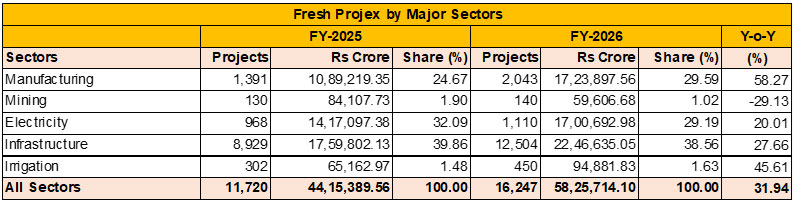
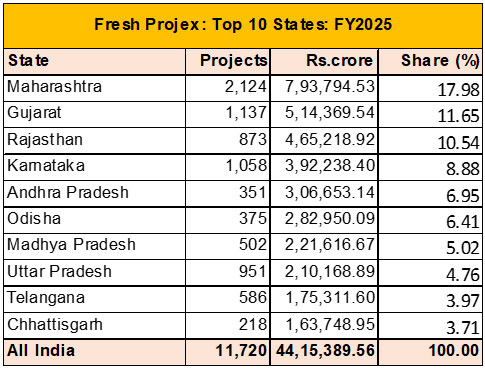
Fresh investment announcements in India registered a strong increase in FY2026 over FY2025, both in terms of project count and investment value. Total project investment increased by 31.94 percent to Rs 58,25,714.10 crore from Rs 44,15,389.56 crore, while the number of projects rose by 38.63 percent to 16,247 from 11,720.
At the same time, the pattern of fresh investment continued to reflect the dominant role of large projects, as has been the case in recent years. In FY2026, mega projects of Rs 1,000 crore and above accounted for 82.00 percent of total fresh investment, compared with 74.57 percent in FY2025. This was the highest such share recorded in recent years and coincided with the largest number of mega projects.
The increase in investment also reflected stronger project activity across several major sectors of the economy. The year saw stronger participation from the private sector, a larger contribution from Manufacturing, continued momentum in Electricity, and a reshuffling in the ranking of leading investment destinations among the states.
By Ownership
The ownership pattern in FY2026 showed a clear shift in favour of the private sector. Private sector investment rose by 51.56 percent to Rs 40,97,723.64 crore, raising its share in total fresh investment to 70.34 percent from 61.23 percent in FY2025. In contrast, government investment was almost unchanged in value terms at Rs 17,27,990.46 crore as against Rs 17,11,734.18 crore a year earlier, but its share declined sharply to 29.66 percent from 38.77 percent.

Within the government category, the movement was mixed. Central government investment declined marginally by 1.07 percent to Rs 8,61,048.84 crore, and its share in total investment fell from 19.71 percent to 14.78 percent. State government investment increased by 3.04 percent to Rs 8,66,941.62 crore, though its share also slipped, from 19.06 percent to 14.88 percent, because total investment grew much faster. The government sector, therefore, remained a major contributor in absolute terms, but it did not lead the investment surge in FY2026.
The stronger movement came from the private sector, particularly from domestic private investors. Private (Indian) investment rose by 40.74 percent to Rs 34,06,667.27 crore from Rs 24,20,491.97 crore. Its share in total fresh investment also improved from 54.82 percent to 58.48 percent. This segment, thus, remained the single largest contributor to overall fresh investment in FY2026.
Private (Foreign) investment recorded an even sharper increase. Investment in this category more than doubled to Rs 6,91,056.37 crore from Rs 2,83,163.41 crore in FY2025. Its share correspondingly rose from 6.41 percent to 11.86 percent.
Thus, the rise in total fresh investment during FY2026 was driven overwhelmingly by the private sector, while public sector investment remained broadly stable.
By Sectors
The sectoral picture in FY2026 showed that the rise in fresh investment was led by Manufacturing, supported by Renewable Power, while infrastructure continued to account for the largest share.
Among the five major sectors, Manufacturing recorded the strongest gain in FY2026. Fresh investment in the sector rose by 58.27 percent to Rs 17,23,897.56 crore from Rs 10,89,219.35 crore in FY2025. Its share in total fresh investment increased from 24.67 percent to 29.59 percent. This marked a substantial strengthening in the sector’s position in the national investment profile.
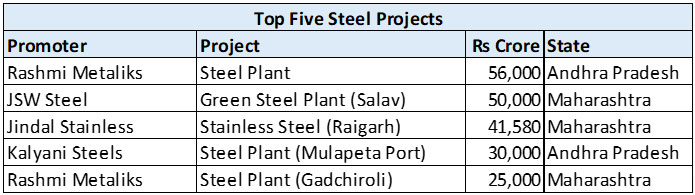
The rise in Manufacturing was led mainly by sub-sectors like Basic Metals, Basic Chemicals, Machinery and Electronics. Investment in Basic Metals increased from Rs 3,41,677.89 crore to Rs 5,92,548.62 crore, raising its share in total fresh investment from 7.74 percent to 10.17 percent. Vedanta's Rs 1,28,000 crore Aluminium Smelter at Dhenkanal in Odisha was the largest single project announced in FY2026.
The following were the five large steel projects announced during FY2026.
Fresh proposals in the Basic Chemicals sector rose from Rs 2,36,720.61 crore to Rs 4,35,711.39 crore, and the Electronics segment saw investment increasing from Rs 1,54,898.17 crore to Rs 2,12,118.11 crore. Among the high-ticket projects announced in the Basic Chemicals sector were Adani Enterprises’ Rs 1,54,000 crore coal gasification projects in Odisha and Maharashtra, and the Green Hydrogen and Ammonia projects of JK Srivastava Hynfra and Yamma in Andhra Pradesh, valued at Rs 35,000 crore and Rs 20,000 crore, respectively.
However, some sub-sectors remained weak. Petroleum Refinery investment, for instance, declined sharply from Rs 1,00,876.12 crore in FY2025 to Rs 20,893.46 crore in FY2026. Within the Transport Equipment sector, Auto Ancillaries recorded growth of 31.92 percent, whereas the main segment, Automobiles, registered a decline of 45.21 percent in fresh investment.
Electricity remained another major sector of fresh investment in FY2026. Investment in the sector increased by 20.01 percent to Rs 17,00,692.98 crore from Rs 14,17,097.38 crore in FY2025. However, because Manufacturing grew faster, Electricity’s share in total fresh investment eased from 32.09 percent to 29.19 percent.
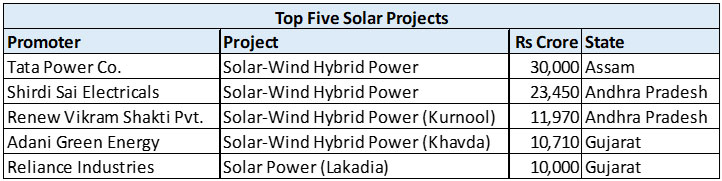
Within Electricity, Renewable Power continued to dominate. Investment in Renewable Power rose by 34.07 percent to Rs 12,57,971.47 crore from Rs 9,38,321.08 crore. Its share in total fresh investment improved marginally from 21.25 percent to 21.59 percent. Solar Power remained the largest component, with investment rising from Rs 6,63,106.18 crore to Rs 9,09,027.40 crore. In the Wind Power sector, investment increased from Rs 2,74,498.21 crore to Rs 3,35,671.87 crore. The major projects in this segment included the following:
The continued flow of fresh investment into Renewable Power projects underscored the sustained policy support and investor preference for energy-transition-related sectors. At the same time, conventional power lost some share in the overall investment profile. Investment in Conventional Electricity (Thermal, Large Hydel and Nuclear) declined from Rs 4,78,776.30 crore in FY2025 to Rs 4,42,721.51 crore in FY2026, and its share fell from 10.84 percent to 7.60 percent.
Infrastructure retained the largest sectoral share in FY2026 at 38.56 percent, though this was lower than 39.86 percent in FY2025. Investment in the sector still rose by 27.66 percent to Rs 22,46,635.05 crore. Thus, Infrastructure remained the single largest recipient of fresh investment, but it did not drive growth as strongly as Manufacturing. The relatively slower growth in infrastructure investment appears to have been associated with lower investment commitments from the Central government.
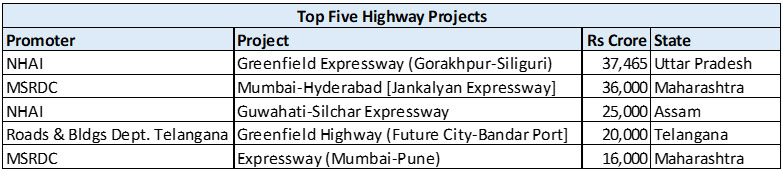
Among the sub-sectors, Transport Services remained the principal component, accounting for Rs 11,11,361.00 crore, up 31.50 percent over FY2025, though its share in total investment was almost unchanged at around 19 percent. Roadways posted only moderate value growth of 16.70 percent and saw its share decline from 11.02 percent to 9.75 percent. The top five highway projects are listed below:
In contrast, Railways more than tripled in value terms to Rs 1,75,510.43 crore, while Shipping Infrastructure rose by 173.17 percent to Rs 1,58,366.34 crore. These two segments emerged as important drivers of infrastructure investment growth in FY2026.
Real Estate was one of the weaker components within Infrastructure. Investment in the segment declined by 23.27 percent to Rs 3,80,739.90 crore, and its share fell sharply from 11.24 percent to 6.54 percent. This was one of the steepest declines in share among the larger sub-sectors.
Two notable projects announced in this sector were a Rs 23,731 crore Affordable Rental Housing project of Navbharat Mega Developers in Maharashtra and a Rs 20,000 crore Bidadi Township project of Bangalore Metro Region Devp. Authority.
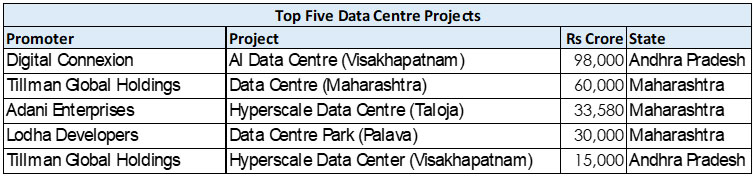
By contrast, Miscellaneous Services, where data centre projects are included, rose nearly sixfold to Rs 3,08,650.50 crore, lifting its share from 1.17 percent to 5.30 percent, though this category was almost entirely driven by mega projects, with a mega share of 99.19 percent. During FY2026, around 54 data centres projects entailing a total investment of Rs 3,08,000 crore were announced. Some of the larger projects were the following:
Mining remained a small component of total fresh investment and weakened further in FY2026. Investment in Mining declined by 29.13 percent to Rs 59,606.68 crore, reducing its share from 1.90 percent to 1.02 percent. Oil & Natural Gas Corpn. proposed to invest around Rs 10,267 crore in onshore oil & gas development projects in Andhra Pradesh and Gujarat.
Fresh investment in Irrigation, on the other hand, rose by 45.61 percent to Rs 94,881.83 crore, though it still accounted for only 1.63 percent of total fresh investment. The Rs 58,000 crore Polavaram-Nallamala Sagar Linking project of the Irrigation & CAD Department, Andhra Pradesh, was the largest irrigation project announced in FY2026.
By States
The state-wise distribution of fresh investment witnessed some important changes in FY2026.
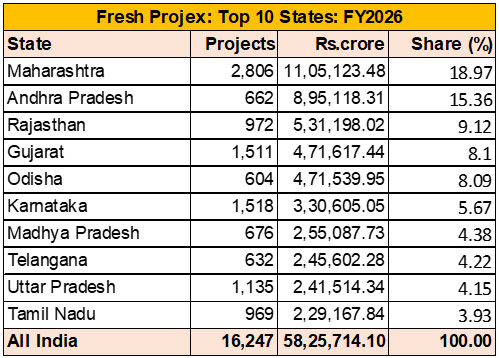
Maharashtra, the largest state economy in India, retained its first position and increased fresh investment to Rs 11,05,123.48 crore from Rs 7,93,794.53 crore in FY2025. Its share in total fresh investment rose from 17.98 percent to 18.97 percent. The state thus remained the country’s leading destination for new investment proposals in the country. Maharashtra’s performance was supported by 164 mega projects worth Rs 9,27,332.05 crore. Of this, the major ones were a Rs 70,000 crore Surface Coal Gasification project of Adani Enterprises, a Rs 60,000 crore Data Centre of Tillman Global Holdings and a Rs 50,000 crore Green steel plant of JSW Steel.
The most significant shift came from Andhra Pradesh. The state moved up from fifth position in FY2025 to second position in FY2026. Its investment rose sharply to Rs 8,95,118.31 crore from Rs 3,06,653.14 crore, while its share more than doubled from 6.95 percent to 15.36 percent. The two major projects announced in Andhra Pradesh during FY2026 were a Rs 98,000 crore AI Data Centre of Digital Connexion at Visakhapatnam and a Rs 90,000 crore HDPE project of Haldia Petrochemicals at Mulapeta Port.
Rajasthan retained the third position, though its share in total investment moderated from 10.54 percent to 9.12 percent. The state attracted 972 new projects worth Rs 5,31,198.02 crore. Among these, the prominent were a Rs 24,974 crore Transmission project of Barmer HVDC Power Transmission and a Rs 11,492 crore Jaipur-Pachpadra greenfield expressway of NHAI.
Gujarat slipped from second to fourth, as its investment declined from Rs 5,14,369.54 crore to Rs 4,71,617.44 crore. A decrease in the number of mega projects led to this slippage. Of the 117 new projects the state attracted, prominent were the twin port development proposals of Deendayal Port Authority (Rs 57,000 crore) and a Rs 28,033 crore Intra-State Transmission System of Gujarat Energy Transmission Corpn.
Odisha rose from sixth to fifth after recording a strong increase in fresh investment, while Karnataka slipped from fourth to sixth following a decline in value terms. Odisha saw the announcement of 604 projects worth Rs 4,71,539.95 crore, and Karnataka attracted 1,518 projects worth Rs 3,30,605.05 crore.
Madhya Pradesh remained in the seventh position with 676 projects entailing a total investment of Rs 2,55,087.73 crore. Telangana (632 projects worth Rs 2,45,602.28 crore) improved from ninth to eighth, while Uttar Pradesh (1,135 projects worth Rs 2,41,514.34 crore) slipped from eighth to ninth despite recording an increase in investment value.
Tamil Nadu re-entered the top 10 states list in FY2026 and secured the tenth position, with fresh investment rising from Rs 98,168.03 crore to Rs 2,29,167.84 crore.
The entry of Tamil Nadu into the top 10 came at the cost of Chhattisgarh, which dropped out of the leading group. Chhattisgarh had ranked tenth in FY2025 with Rs 1,63,748.95 crore of investment, but fell to twelfth position in FY2026 with Rs 1,12,575.88 crore. This was the only change seen in the composition of the top 10 states during FY2026.
The overall state-wise pattern indicated that fresh investment remained concentrated in a relatively small group of leading states, but there was notable movement within that group. Maharashtra consolidated its leadership, Andhra Pradesh emerged as the most improved state in the ranking, and Tamil Nadu re-entered the top tier.
Outlook - FY2027
FY2026 recorded a strong year-on-year increase in fresh investment, led by private sector participation, a marked improvement in Manufacturing, and sustained momentum in Renewable Power. In this sense, the year marked a clear strengthening in investment intentions compared with FY2025.
However, the year-end pattern also suggested that the investment climate may have become less supportive toward the close of FY2026. The quarterly figures for fresh investment suggested that the final quarter (Q3-FY2026) witnessed a sharp decline in fresh investment after the first three quarters had shown greater resilience. This late-year weakness assumes importance because it may influence investment trends in the opening months of FY2027.
The factors that affected the last quarter's performance included geopolitical uncertainties, the war in the Middle East, US tariff-related concerns, weakness in exports, and fears of inflation arising from higher petroleum prices. Such uncertainties tend to influence private investment decisions more quickly than public spending. Hence, the private sector investment commitments, especially large private proposals, may decrease in the first half of FY2027. That risk becomes more relevant because FY2026 growth was heavily supported by mega projects.
The immediate outlook, therefore, points to slower and more selective investment growth rather than another broad acceleration. Under such circumstances, stronger public sector capex may be required in FY2027 to sustain the overall investment momentum.
About Projects Today
Projects Today is India's largest online databank on new and ongoing projects in India. The website, launched on 8 September 2000, aims to provide the required foresight to its clients based on sectoral insights its research team possesses. The project-related information provides an invaluable marketing resource to assist the business development efforts of the organisations that focus on the new projects market. It is widely used by the project fraternity, primarily, as a business opportunity identifier.
Projects Today conducts Survey of Project Investment, at the end of every financial quarter to gauge the trends in projects investment in India by sectors, state, ownership, etc.
Disclaimer : The opinions expressed within this interview are the personal opinions of the interviewee. The facts and opinions appearing in the answers do not reflect the views of Indiastat or the interviewer. Indiastat does not hold any responsibility or liability for the same.










.png)